


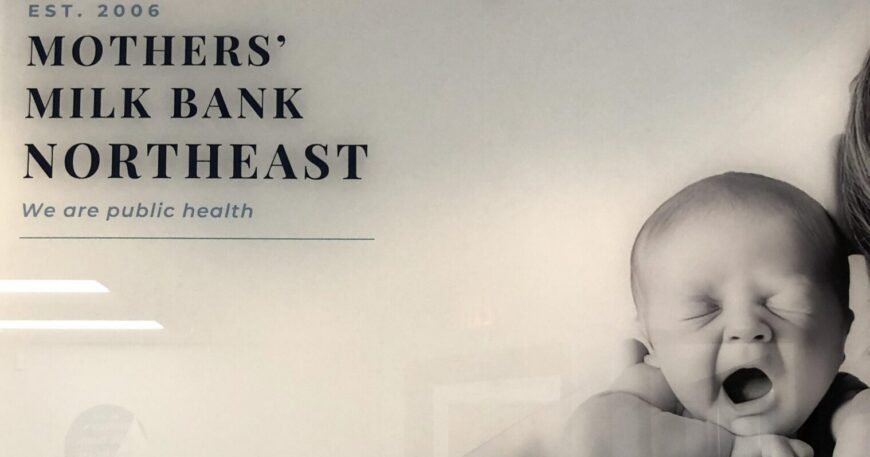
Mothers’ Milk Bank Northeast has been featured in news stories, by healthcare organizations and through professional associations across the United States to help raise awareness of milk banking and the life changing impact donor milk can make for babies and their families. In fact, 2026 marks the nonprofit’s twentieth year “of providing a lifeline to babies who need it most.”
Wait a minute, MassMEP is an organization that works with manufacturers. Manufacturing for a New Generation? Manufacturers take raw materials, work procedures, blueprints or formulas, then using tools, equipment and quality assurance procedures, make them into finished products. So does Mothers’ Milk Bank Northeast. In fact, in 2025 the organization provided breast milk to approximately twenty-two thousand babies: the new generation.
 Picture a young couple expecting their first child. Ecstatically counting the days! The mother goes in for a regular appointment and is told that the baby is in distress, and they will need to deliver by C- section as soon as possible. After the C- Section the tiny boy endures additional medical procedures and now is fighting for his life. Delivering eight weeks early, mom is not yet producing the milk needed to help nourish and protect her son.
In comes a nurse with several small bottles. These bottles came from Newton based Mothers’ Milk Bank Northeast. This accredited non-profit milk bank provides safe, pasteurized donor human milk to over one hundred hospitals for situations just like this. It is especially critical for premature or medically fragile babies whose internal systems may not yet be fully developed. They need the rich nourishment of human milk, with its antibodies and immune boosting properties to fight infection and help them heal and grow. These bottles contain the closest thing available to what their mother would provide.
Mothers’ Milk Bank Northeast also provides donor milk to families who want to breastfeed their baby but need supplementation while their own milk supply develops. Supplementing with donor milk, rather than formula, has been shown to improve breastfeeding outcomes, leading to significant health benefits for both mothers and babies.
Last year, more than 203,000 bottles from Mothers’ Milk Bank Northeast were delivered to hospitals or families in need.
- One in ten infants require care in the NICU.
- Approximately 90% of hospital NICU’s rely on donor milk.
- Just one ounce of donor milk equals three meals for a very premature infant.
- Human milk significantly lessens the risks of certain life-threatening conditions prevalent in premature and medically fragile newborns.
The “Milky Way”- Mothers’ Milk Production Process
The organization’s current process they refer to as, “The Milky Way.”
- Mothers’ Milk Bank Northeast begins by educating the community about the lifesaving role of donor milk and the services it provides through public awareness efforts and health care referrals.
- Prospective Donors are medically screened for safety and eligibility to ensure they are healthy. This usually takes a few weeks and much communication.
- Approved milk donors ship their milk. Donors receive boxes and supplies to ship their milk to the milk bank.
- Milk donations are diligently documented for safety as donor milk is received.
- Lab Technicians pool milk for optimum nutrition. As milk is needed, the frozen bags are thawed in refrigerators.
- Thawed milk is mixed into batches and pasteurized by regulations using The Holder method of pasteurization which requires a water bath at 144.5 degrees F for 30 minutes. This process destroys harmful pathogens while preserving most of the milk’s nutrients, helping to support and protect the babies who receive it.
- Pasteurized milk is independently tested for bacteria. Samples from each batch are shipped to a third-party lab for testing.
- Approved bottles are distributed to hospital units and outpatients
These eight steps are repeated continuously.
Nothing Mechanical About this Process
When you break it down as a manufacturing process, the steps begin with receiving donated breast milk from women across the northeast, then they process, pasteurize and bottle the milk to ship to hospitals in need. There is nothing mechanical about this process. At the very heart of it are the women who donate milk and the infants who are receiving their life sustaining gift. There is a very human element involved in this manufacturing process which greatly affects the organizations’ success. The Donors. This is the milk bank’s Supply Chain if you will. In 2025 the organization engaged with 1,604 donors. Can you imagine having that number of raw material suppliers to work with every day? Well, they don’t. The number of donors changes with each date on the calendar.
Finding the extremely generous and selfless women who have more milk than their own baby needs and are willing to donate it to help another baby is key to ensuring that every baby who needs donor milk to grow and thrive can receive it. And women only lactate for a finite period, so the need for new milk donors is ongoing. Ultimately the milk bank can only fulfill its mission of protecting the health of medically fragile babies because of the immense generosity of those who choose to give.
Manufacturers at their Core
With the very human, emotional and wellness aspects of what is being done at Mothers’ Milk Bank Northeast, it can be easy to forget that at their core, they are a manufacturer. They face the same challenges any other manufacturers do, which is how their CEO Deborah Youngblood happened to contact Mass MEP. The milk bank had been looking across the state and thinking about who could contribute to their strategic growth goals – looking for consultants and partners. The organization works with healthcare and with MA Life Sciences. MassMEP came up in conversation.
Youngblood took over as Mothers’ Milk Bank Northeast’s CEO in 2022. Over the past four plus years, the organization has nearly doubled in size. “We’ve made hundreds of little changes that have led to improvements along the way.” says Youngblood. Now they have partnered with MassMEP, and Project Manager Kristen Binienda, to make larger improvements to their current state, in their current location as well as to look to the future and plan what the organization will need moving forward and help Mothers’ Milk Bank Northeast continue to do what they do so well.
Getting to Work
Deborah and a team of Mothers’ Milk Bank Northeast employees worked with Kristen to map out the organization’s current state and look at their layout and process flow. Their offices are in an old mill building with many small rooms that are now filled with freezers and refrigerators and processing equipment which has resulted in a crowded and somewhat disjointed layout. Their receiving area is hard to maneuver. When they get supplies delivered, any available employees stand side by side and hand boxed from person to person like a “bucket brigade,” to unload trucks. Finished product has to be moved from the end process, back to front door for shipping or pick-up, this is also the entrance to their office. As Kristen discovered, there are problems with layout and flow before and after the pasteurization process along with time spent waiting and moving product back and forth.
 After four days of mapping, walking and discussing their current state the team had come up with many good ideas. Binienda encouraged them to take care of some “low hanging fruit”, simple projects that cost little and can have great impact, between their mapping sessions. “They did not disappoint,” shares Kristen. Everyone had improvements to share or additional ideas they thought of. Kylia Garver, the organization’s Chief Program Officer who handles donor screening and engagement, “was amazing”, says Binienda, “She made several improvements right off the bat to help streamline some of her administrative tasks.” The team was happy to be invited to come up with ideas that will help them in their jobs. Afterall, they are the experts. Simple changes add up, like switching to different size trays that could hold more product in a specific space. Taking this time to study their processes resulted in a suggestion from Deborah that they needed to improve the organization of the freezers. The team continue to add more to their “to do list” while preparing for the next phase of their work with MassMEP.
Kristen returns to the milk bank next month to start implementing some of the changes they have discussed. She will be joined by MassMEP project manager, John Grover, who has lots of experience with Systematic Layout Planning, to help make their current space work better for them. There will also be discussion about the next phase as their organization continues to grow.
There is much more than a manufacturing process going on at Mothers’ Milk Bank Northeast. Their communication with Donors and the screening and healthcare procedures, the recordkeeping and receiving the milk donations themselves are a major part of Mothers’ Milk Bank Northeast’s process and impacts their existence. The objective will be to determine how to help the organization keep up with the increasing demand for product in their current footprint and streamline all their processes while making sure every detail is considered and executed strategically to keep everyone and everything safe.