



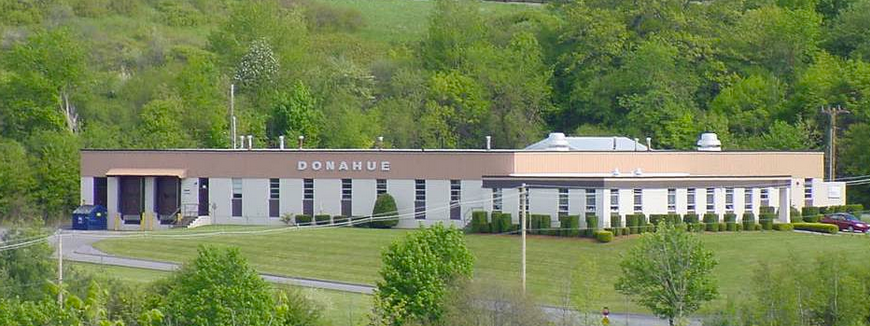
 Donahue Industries, Inc. has been a Shrewsbury manufacturing business for almost fifty of their sixty-seven years in the industry. They began by producing stamped metal parts for the abrasive and grinding industries and sheave gauges for the wire rope industry. As the company has grown, their capabilities and services have expanded to provide customized and precision offerings to additional industries like medical devices, electromechanical devices, prefabricated steel structures and brackets and fasteners for aerospace. In addition to steel, they work with aluminum, brass, plastics, and composites. Today, the company’s three major focuses are: High Volume Press Metal Stamping, Medium to High Volume CNC &
Swiss Auto Lathes with Live Tooling and Machining and Tool Making.
“What can we produce for you?”
Donahue Industries is proud to offer complete design to manufacturing capabilities. This small but mighty organization of ten employees is one of only two companies in Massachusetts with a fully accredited toolmaker apprenticeship program. They truly invest in their future.
Joseph Draleau, Donahue Industries VP of Operations, was asked what initiated their recent work with MassMEP. “We were visiting a potential vendor and were introduced to John Grover, a MassMEP project manager who was there working with them on 5S improvement projects,” says Draleau. “Donahue had worked with MassMEP in the past with good results, but with recent growth, additional processes, and new staff members our housekeeping procedures had begun to suffer. Seeing John working with this other company reinforced our desire to get back on track again here at home!”
The Projects Begin
During an initial meeting with MassMEP in October 2025 Donahue Industries discussed their current business challenges and their priorities and goals for the next several years. Tooling and material organization and inventory management were at the top of their list of challenges and seemed to be a good starting point for their project work.
Committing the time and people to training with a third party like MassMEP to help their teams develop processes for cleaning, organizing, and labeling their tools, materials, and inventory, often seems to make employees take it a bit more seriously than if this was being done internally. It puts everyone on the same level since they are all learning and working together to make improvements.
In the Tool Room – Rapid Improvement Kaizen
As new employees joined the company and things continued to get busier, items were not always put back where they belong. Tools were left at machines or wherever they had been used. Employees were getting frustrated when they went to quickly grab a tool and instead had to spend time searching for it. The more time spent looking for things the less time is spent producing product!” said Draleau. Donahue’s more experienced employees were used to having things kept and done in specific ways and newer employees were developing their own methods and habits. This caused friction and discomfort for everyone.
A team with members from Donahue’s three manufacturing cells worked with Grover on the 6s Kaizen. The team created their Problem Statement looking to standardize locations of tools and equipment to eliminate delays and wasted time during production and to organize the work area to eliminate extra motion, extra travel and extra searching which was keeping them from performing value-added work. This statement became the mandate for their work in the Tool Room
The project began with classroom training to help the team learn about the different types of waste they might find in their processes. Then they went to the Tool Room to identify the waste there. After determining what they needed to address, the group created an action plan assigning tasks and completion dates to each member. The action plan was kept active through review at weekly team meetings until all actions were completed. “During the 6S event, the team identified opportunities to sort out unneeded items, set- in-order frequently used tools, and shine and clean the workspace,” shared Grover. “They also developed new standards to support efficient workflow, consistency, and safety—ensuring customers continue to receive the highest quality products, delivered on time!” Check lists and other tracking measures were created to help ensure the team’s improvements are sustained.
Cabinets, drawers, toolboxes, and shelves were cleaned and organized, tools and materials were inspected, labeled, discarded, repaired, or replaced. Activities like the installation of foam drawer liners were done, where the shapes of the tools are cut out of the foam so only a specific tool will fit in each spot. This makes it very easy to see what is missing at-a-glance and exactly where the item needs to be put away. Standards were created as to what goes where and how each drawer or cabinet should look at the end of the day and all employees are kept accountable.
The Tool Room Team created standard processes for cleaning and organizing their tools and parts that make it easy to put them back where they belong and easily and quickly found which will make work go more smoothly and quickly.
Shipping Area – Rapid Improvement Kaizen: The problem statement outlined that ineffective organization of materials including obsolete and slow-moving inventory, along with material stored in multiple locations, caused it to take excessive time to locate items for shipment, resulting in shipping delays and reduced customer satisfaction.
Donahue makes assemblies and carries the components which are critical to making those assemblies. In the shipping area there were six racks stacked with boxes. The boxes and racking were not labeled consistently to identify what materials were being stored. When working in the area the team discovered that some boxes had little or no material in them but had been put back on the shelves instead of being combined, re-labeled, or thrown out. Additionally, boxes and other debris randomly stacked or left beside the racks and near walkways created a safety hazard.
During the Shipping Area Kaizen, boxes of materials were consolidated and labeled to indicate content and quantity. This allowed the number of racks in the area to be reduced from six to three. The shelving was also labeled to identify location of materials. Empty boxes were flattened and recycled. Now everything has a “home” and is easy to find. The team took inventory and initiated a kanban system with cards to indicate inventory levels and when to reorder materials.
- Everyone felt good about throwing away all the clutter that was interfering with their productivity and potentially impacting safety. They now have inventory on the shelves that they can trust and aren’t finding empty boxes when they thought they had materials.
- The component inventory and re-ordering processes are efficient.
- Consolidating the racks from six to three freed up significant space which the company can utilize for more capital equipment.
Benefits from the Kaizen Projects
Employees saw their company investing in these projects and allowing them time to train and do the physical cleaning and organizing with John. They realized the importance of what they were doing and that they will all benefit from an organized, clean, and safe environment to work in, to make products for their customers in and to expand their business from. Throughout their improvement projects another crucial element was the creation of standard methods for keeping the improvements on track, training everyone in the new processes and then holding everyone accountable for maintaining the positive changes by implementing sustainment procedures.
“Friday afternoon clean-up used to take several hours and now takes about 15 minutes! offered, Draleau. “As a result, Donahue Industries has been able to increase our production time on Fridays significantly!”
Everyone learned that sometimes taking the “easy way” costs even more time in the long run. Developing processes and doing things the right way benefits everyone. The improvements are being sustained.
“The Donahue Industries team is fully committed to sustaining these improvements while holding safety to the highest standards. “It’s always rewarding to work with teams that embrace teamwork, discipline, and a culture of continuous improvement!” John Grover
- Donahue Industries employees are seeing that what they have done is really making a difference. They were given improvement tools and were involved with the process. Now they have ownership from being part of the team and the desire to keep things in order because it benefits everyone. The morale of the entire team has improved.
- Efficient component inventory and re-ordering.
- Space freed up for additional capital equipment.
- Safety has improved in the facility by removing potential tripping hazards.
- Donahue teams have morning kick off meetings to reiterate that everyone relies on each other and the importance of being and working as a team.
- Since doing these improvement projects, Donahue Industries have had long-standing customers and vendors visit the shop and comment on how great the place looks. “It makes our employees feel proud of their workplace!” adds Draleau. “Years ago, when I would get a call that we were having a customer or vendor visit, we would spend hours running around cleaning and decluttering. Now when they call to visit, I can say, Come by any time!”
- “The workshops were presented in a manner where they were easily understood by everyone, shared Draleau. “Now we plan to take what was learned and use it in other areas of the company.”
John Grover sent an email to Donahue’s Kaizen team, after a recent visit, touring the areas they had worked on. He was thrilled to see that their enthusiasm and the momentum had continued. “It is always refreshing to walk into a facility where the team is clearly invested in what they do. Your people are not just there to collect a paycheck- they genuinely care about the organization and about making a difference while earning a living. That kind of culture is noticeable and admirable!
Joseph Draeleau, responded on social media “A big thank you to John for the kind words and encouragement following the recent visit. The feedback and support mean a great deal to all of us. Recognition like this reinforces the importance of that work and the progress being made across the floor. Thank you again, John and MassMEP — we truly appreciate your guidance and partnership!