



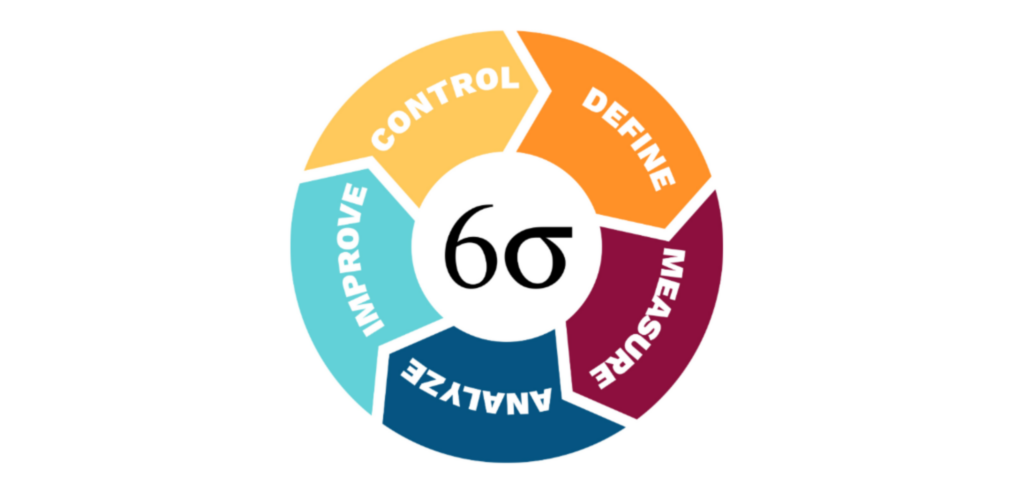
The name Six Sigma sounds a bit Greek to me; something scholarly or scientific. When you include the word Lean it implies that it could also help get rid of the excess. Lean Six Sigma is actually a problem-solving methodology focused on Lean continuous improvement concepts of eliminating waste and improving processes while “taking it up a notch” by using the science behind the DMAIC framework (Define, Measure, Analize, Improve and Control) to go even further towards improving quality, speed, efficiency and customer satisfaction across industry. Six Sigma focuses on reducing defects and variation as part of eliminating waste and improving production speed.
And if you think about it, eliminating waste from products and processes, both in manufacturing and business, does in fact get your company in better shape!
Over the past several years, MassMEP has developed and delivered Six Sigma Yellow, Green and Black Belt training programs. Richard Goyette, a Master Black Belt instructor says these programs teach students to “look to the data to understand what the actual problem is.” Six Sigma is taught through ascending levels or belts beginning at the white/yellow belt stage which focuses on learning and practicing the steps of the DMAIC framework. For Green Belt, an eighty-hour training course, students utilize full application of the DMAIC roadmap, display a demonstrated understanding of the Six Sigma concepts and create a project which will result in at least $50k savings in cost of poor quality (COPQ). Six Sigma Black Belt is one hundred-twenty hours of training, and involves advanced application of the DMAIC framework, proven understanding of Black Belt concepts and creating a project which will result in at least $100k savings in COPQ.
Numerous companies have participated in Six Sigma training either as part of a consortium group of several companies or when their own organization offered the courses internally. Following are thoughts from program graduates, companies and instructors on the training, its objectives and benefits and why companies are looking to “bring the data” to their Continuous Improvement efforts.
Cartamundi, a global manufacturer of card and board games, in East Longmeadow, has had participants in both Green and Black belt training programs. Through application of analytical tools, process controls and waste reduction strategies during the Green Belt program, the company realized significant annual cost savings and waste reduction and has seen recurring savings in these areas since. Peter Letendre, Cartamundi’s Director of Operations is also a Six Sigma Black Belt. He comments, “I have always believed that making manufacturing decisions based on data is critical. While many organizations focus heavily on Lean principles, I believe reaching the next level of manufacturing performance requires embracing the Six Sigma methodology as well. Lean helps eliminate waste, but Six Sigma adds the analytical rigor and statistical approach needed to identify root causes, reduce variation, and sustain improvements.
Helping companies take their Lean Continuous Improvement efforts to the next level is one of the reasons MassMEP Instructor Mike Green likes teaching these courses. “The main reason I enjoy teaching Six Sigma, shares Green, is because it’s a way to see patterns and understand processes that otherwise can be really hard to recognize and could come down to guesswork. When participants start to use the tools and see how to make sound decisions based on this, they can now be confident that they’re doing the right things and can have next-level impacts on overall business performance!”
Fact To reach Six Sigma means achieving a defect rate of only 3.4 defects per million opportunities which is near perfection in processes. This is accomplished through structured methodology that emphasizes quality improvement and operational efficiency.
Julia Awad, a Process Engineer from Sika Corporation, in Canton, worked with MassMEP on a grant to bring both Green and Black Belt training to her company. She also participated as a student in the Six Sigma Black Belt training. Sika ran both trainings on alternate weeks Green Belt with instructor James White and then Black Belt with instructor Michael Green. Awad says that spreading the training out over a longer period got them used to having MassMEP in the building. The longer time frame also made the pace easier for them to fit into their busy work schedules.
Why did Your Company Get Involved with Six Sigma training?
“There were a couple of reasons,” says Julia. “While going through the grant process I noticed that Six Sigma hadn’t really existed at our company before. I had always been interested in bringing the training to Sika. Admittedly, some people were a bit hesitant about it, thinking that Six Sigma was some sort of cult! It’s not a cult,” she laughs, “but a toolbox where you can pick what you need to solve problems and make improvements.” The training also provided Sika Corporation staff members with some background in Lean. For some it was a review, while others had no prior exposure to Lean at all. “It was an introduction to the Continuous Improvement concepts and way of thinking, with the addition of having projects to work on and that work be data driven.” “Here at Sika, she adds, “if you want to prove your point or you want to make a change or improvement, they will let you, as long as you can prove the value with data!” “That’s the big thing for us, at least from the engineering and quality perspective!” says Awad” Implementing Six Sigma’s tools allows engineers and quality personnel to justify improvements or changes through empirical evidence. Having that evidence was key for Sika participants.
“I love when something clicks for the students,” shares James White, who instructed the Green Belt class at Sika. “They realize this (Six Sigma) could be very effective on the production line or somewhere in the business, which could make an improvement to the products’ quality, cost, or delivery!”
Sika’s Green and Black Belt class participants were a cross-functional mix from different departments, making the training more valuable to some than others for their day-to-day work. The primary goal of the training was to introduce data-driven decision-making and Lean concepts to employees with varying levels of exposure. “All the participants benefitted differently,” adds Julia, “but everyone benefitted!”
What did you get from the training? Was it time well spent?
“It’s kind of like being part of an ongoing Six Sigma project, with something more to discover or figure out all the time! I love this kind of work!” shares Awad. “There are always improvements to make! We use Six Sigma tools regularly on incremental types of things more than for complete projects!” Often, they end up using the tools to help with things that come up unexpectedly. Production will say, “Oh my gosh, how did this happen?” Then we look at the data and say, “Ah, this is why it happened! We can actually show people that this was not a new problem,” says Julia. “It has happened before, and here is the data to prove it.” In that way Awad says that the tools and processes have been very helpful to her in her role.
“I certainly think there’s a lot of value in the application of tools, the data we are collecting and in many of the projects that we did and are still doing. For instance, we have SPC (statistical process control) and capability check-ins at quarterly meetings and we regularly analyze key parameters and then make sure that everything is being maintained.” They use different aspects of Six Sigma to help them do things, regulate things and improve things. “Let’s say something goes wrong,” shares Julia. “I’ll use the data. I’ll do correlation analysis to see if there have been changes or if elements are connected to each other, so again, I am using Six Sigma for justification. A month ago, we thought that something changed or shifted and now I can prove it with the data I have collected,” she says. “And I learned it through Six Sigma training!”
“Many companies recognize the value of Six Sigma,” said Peter Letendre, “but view it as too complex or too time-consuming to implement. At Cartamundi, we are part of a large global organization headquartered in Belgium that has traditionally focused on Lean initiatives and cost savings. In East Longmeadow, we made a conscious decision to strengthen the Six Sigma side of our continuous improvement strategy by investing in Green Belt and Black Belt training”
Letendre has always appreciated Lean, but for manufacturers striving for world-class performance, he believes Six Sigma is the missing piece. Lean improves flow and reduces waste. Six Sigma puts science into manufacturing by using data to drive decisions and solve complex problems. Together, they provide a powerful foundation for continuous improvement.
“My favorite part of teaching the six sigma (Green Belt) class would have to be sharing real world examples with the teams of how to apply the concepts, make real changes, and save companies real money!” James White, Instructor MassMEP
Outcomes
“One of the most valuable outcomes has been our ability to grow internal capability,” says Letendre. “We now send our Continuous Improvement Leader and other Black Belts to support additional sites by teaching Yellow Belt programs, and we are developing a Green Belt curriculum that can be deployed throughout other Cartamundi locations. This allows us to invest in employees while creating long-term, sustainable improvement capability across the organization.”
Mike Green echoes the benefits of the Six Sigma experience, suggesting his best implementation scenario:
- Use the Six Sigma methods we teach to identify the biggest issues and root causes holding a company back.
- Use the Lean and Continuous Improvement tools we teach to implement effective solutions in a sustainable way.
- Use the Leadership and Management skills we teach to motivate and communicate the “why” and then bake the solutions into the way the company does business.
As part of a two-year general grant, Incom of Charlton provided Six Sigma Green Belt training to several employees. After the first year of the grant in 2024, the company saw $210k in savings over a wide variety of Six Sigma Green Belt projects and had projected savings of over $450,000 for the next year. Additionally, the company has seven Six Sigma Green Belts who continue to implement improvement projects!
Peter Letendre explains that the return on that investment for Cartamundi has extended far beyond the individual Green Belt and Black Belt projects. By developing employees’ problem-solving skills and giving them the tools to analyze data effectively, the company has created a culture where employees at many levels are identifying and leading smaller improvement projects that collectively deliver significant results. “Every year we are challenged with aggressive savings targets, and since expanding our Lean Six Sigma training efforts, we have consistently met or exceeded those goals.”
The primary objective for introducing Six Sigma at Sika Corporation was to foster a data-driven culture where employees can justify improvements through statistical proof. Through the training they learned to use the tools, gather the data and are now able to do projects on their own and train others in Six Sigma. They described that Lean only went so far and that utilizing Six Sigma has helped them furnish the details, the measurements and the statistics that are required to drive next steps. The scientific methodology provides confirmation that will allow leadership to make informed decisions about investments and the future. The data can prove a point, emphasize facts or the effectiveness of something that may be the tipping point to making big changes. Six Sigma tools and processes support successful continuous improvement projects enhanced by comfortable, factual, data driven decision making!
I would absolutely recommend (Six Sigma) training to other organizations. The skills developed through Green Belt and Black Belt programs not only produce measurable project results but also create a culture of structured problem-solving that continues to generate value year after year!” Peter Letendre, Director of Operations, Cartamundi
At the request of several companies Mass MEP is currently putting together new Green Belt consortiums. These will be offered regionally. MassMEP offers Six Sigma Certifications that can help communicate those skills across the industry. If you are interested in helping your company “take it up a notch,” please contact MassMEP to learn more.