



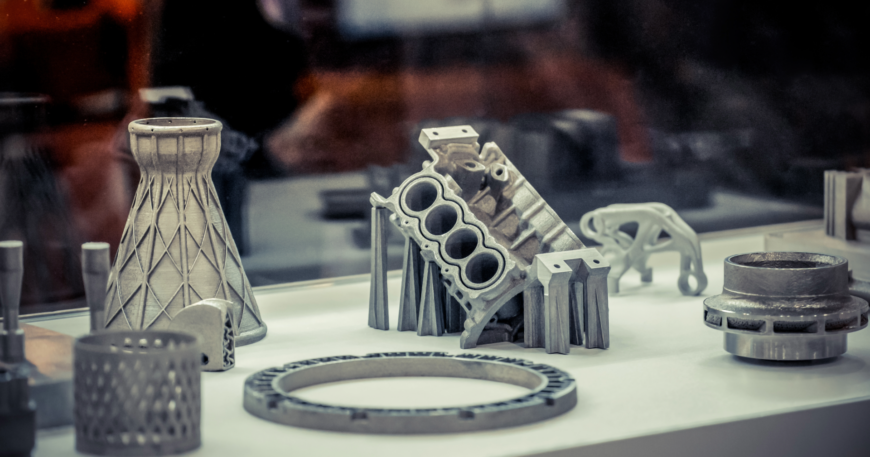
“We wanted to create an additive program that covered the basics while also showing real-world applications,” says Richard Goyette, MassMEP’s Smart Manufacturing Program Manager. After connecting with David Follette at UMass Amherst, and seeing growing interest from manufacturers, MassMEP partnered with him to develop the Applying Additive Manufacturing to Your Manufacturing course. The program is delivered by Follette at UMass Amherst and by Ted Green at Wentworth Institute for companies in the Boston area.
The three-day training helps companies identify practical opportunities for additive manufacturing within their operations. The first two days take place on-site, where participants learn about materials, applications, and design — then walk the shop floor to spot where 3D printing could be applied. 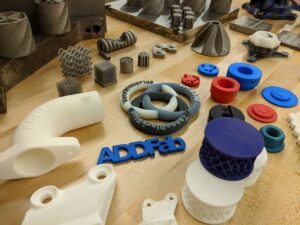 The focus is hands-on, with teams modifying existing parts or designing new ones that can often be prototyped quickly and at low cost. One of the biggest advantages of 3D printing is speed and flexibility — especially for one-offs, prototypes, small runs, fixtures, and jigs. In many cases, everyday workarounds like zip ties or duct tape point directly to opportunities for custom 3D printed solutions.
The third day takes place at the ADDFab Lab at UMass Amherst, where participants see the capabilities of advanced 3D printers using materials like metals, composites, and flexible polymers to produce production-grade parts. While these machines offer impressive capabilities, they are more complex and costly to operate, which is why companies are often encouraged to outsource high-end printing rather than invest in the equipment themselves.
“I consider myself a “3D printing evangelist” with the mission of advancing the understanding that 3D printing is more than just making trinkets and action figures,” laughs Follette. He wants to spread the news about how to apply 3D printing in industry because people really don’t yet have a good understanding of all the applications. “Rapid prototyping and low volume manufacturing of plastic parts and fixtures doesn’t make sense to do with injection molding,” he says. “Traditionally, prototyping has been done in aluminum on a CNC because it fast and affordable. 3D printing allows plastic parts to be made very quickly at low cost and can be the perfect solution in applications where the strength and durability of aluminum isn’t required. And, it allows production machines to focus on production.”
Belt Technologies Inc., of Agawam, has been a manufacturer of metal conveyor belts, metal timing belts and pulleys for conveyor systems and other automation applications for more than fifty years. “They are experts at their CNC process and had never considered producing 3D parts in plastic,” says Follette. “Many people have only seen it used for toys and don’t give it a chance for other applications,” he adds. “Like most manufacturing processes, you do need to design the part with the process in mind. Although you can 3D print parts designed for sheet metal or CNC, it is best to optimize the design for the 3D printing process, which is where we help,” shares Follette. 3D printing has been around since 1980’s, but the technology has made huge strides in last ten years. There continues to be more uses for 3D printing as the quality consistently gets better and the pricing no longer keeps it out of reach.
Through the Applying Additive Manufacturing to your Manufacturing program, Follette worked with Belt Technologies’ mechanical engineering team on a design for a specific application. “We produce custom belt systems,” says Alan Wosky, Belt Technologies, President. “The cost is high to produce these custom pulleys that have mechanical timing applications. In our new TruTrack™ Pulley, there is an aluminum wedge that is a component of the pulley and weighs over 10lbs. Our team was able to design, and 3D print some components of the pulley, and reduce the weight by about 70%! The weight reduction substantially decreased the mechanical response time to track our steel belts.
Plastic wears faster than metal, so we are testing to see where 3D printed parts make sense,” he adds. “Being able to print components gives us the opportunity to do testing on our side. The prototype has been installed on a demo unit and has been running for several weeks without showing wear!” The UMass ADDFab Lab also printed another complete pulley for them and Belt Technologies will be testing that soon as well. Wosky believes it should work.
Our team’s experience with the training course through UMass “was an immediate hit- very positive!” says Wosky. The company has been able to use 3D printing to solve a quality issue with some tooling that they had been machining and are currently using 3D printed parts for tack welding operations on their manufacturing floor.
“Belt Technologies supplies customers with pulleys made of aluminum or steel, adds Wosky. “We have utilized 3D printing to assist with design which allows us to test first, before launching a new product. 3D printing provides an excellent alternative for prototyping and for smaller production runs,” he adds. “The process is very fast!”
“Dave Follette’s group (at UMass) is excellent to work with,” stated Wosky. “They are extremely knowledgeable and even offer design assistance. Our work with them has been very beneficial. The opportunity for us to test prototypes, solve problems and prevent headaches before production is a large time and cost savings. Being able to print 3D parts that can be used in our products is another huge benefit!
Now that they have had time to learn and test and have seen what Additive Manufacturing could mean at Belt Technologies, Wosky believes the company will invest in their own 3D printer this year.
David Follette is a strong proponent of companies owning low-cost 3D printers but adds that before investing in a higher end printer, companies can utilize UMass for their printing needs and to test out different machines to see what works best for their application.
David adds, “It’s been great to help so many companies discover that 3D printing is more than just trinkets and learn how to take advantage of its strengths and apply those to their business. We look forward to helping more companies in the future!”
For more information about the Applying Additive Manufacturing to your Manufacturing course, or about renting a 3D printer to test at your company, contact MassMEP’s Richard Goyette at rgoyette@massmep.org, (774)633-6489.